
In 2003, I took a temporary role with a struggling technology startup. They offered auto-dialing services primarily to non-profit organizations like camps, sports teams, and schools alone with emergency preparedness plans for business clients. Essentially, our users would call into our computer system to record a message they needed to get out (e.g., "school is cancelled due to weather"). Our system would then rapidly call each phone number on the user's pre-loaded call list and play the message. The company literally made pennies per call. As I took more and more responsibility, eventually becoming president of the company, it became clear that if we were going to make money, both our telephony system and website needed to be incredibly simple to use. Getting clients wasn't enough; they had to use the system often for us to turn a profit.
That was before the Internet community was using words like Experience or User-Centered. But the truths later solidified into the tenants of a professional practice were self-evident even then. People come into an experience with an idea about how they think it will function ,and respond. When an experience is confusing, time-consuming, or seemingly broken, users will quickly abandon and look elsewhere for a solution to meet their need.
For the last 14 years, I have worked in the field now known as User Experience. I have worked as a designer (Graphic, Web, Interface, and UX), an information architect (IA), a front-end developer, and a team lead. I have managed products, driven strategy, measured ROI, led usability testing and research (qualitative and quantitative), and poured over analytics data to measure effectiveness and identify areas of iterative improvement.
In that time, I have come full circle. From a time where no one person or team was tasked with "user experience," to being the "voice of the customer," to leading entire teams devoted to meeting user expectations, to again maintaining that the user's experience is the result of all of the work produced by the entire business, design, and development teams. I advocate that UX isn't as much a position as it is a mind-set that should influence each team member's work within their given discipline.
This mindset makes integrating a UX practice into any methodology such as Agile much more simple and effective. When an entire team biases their work based on likely user desires and needs, there is a shared thread that connects each discipline and makes collaboration easier and more effective. When Jesse James Garrett wrote one of the first books on the topic, The Elements of User Experience: User-Centered Design for the Web, (which has since been updated) he wasn't writing to UX professionals. He was talking to web professionals. And really his focus on the user wasn't new. It was just a bit new in the web space. UX is simply a sibling to human-factors, ergonomics, heuristics, etc.
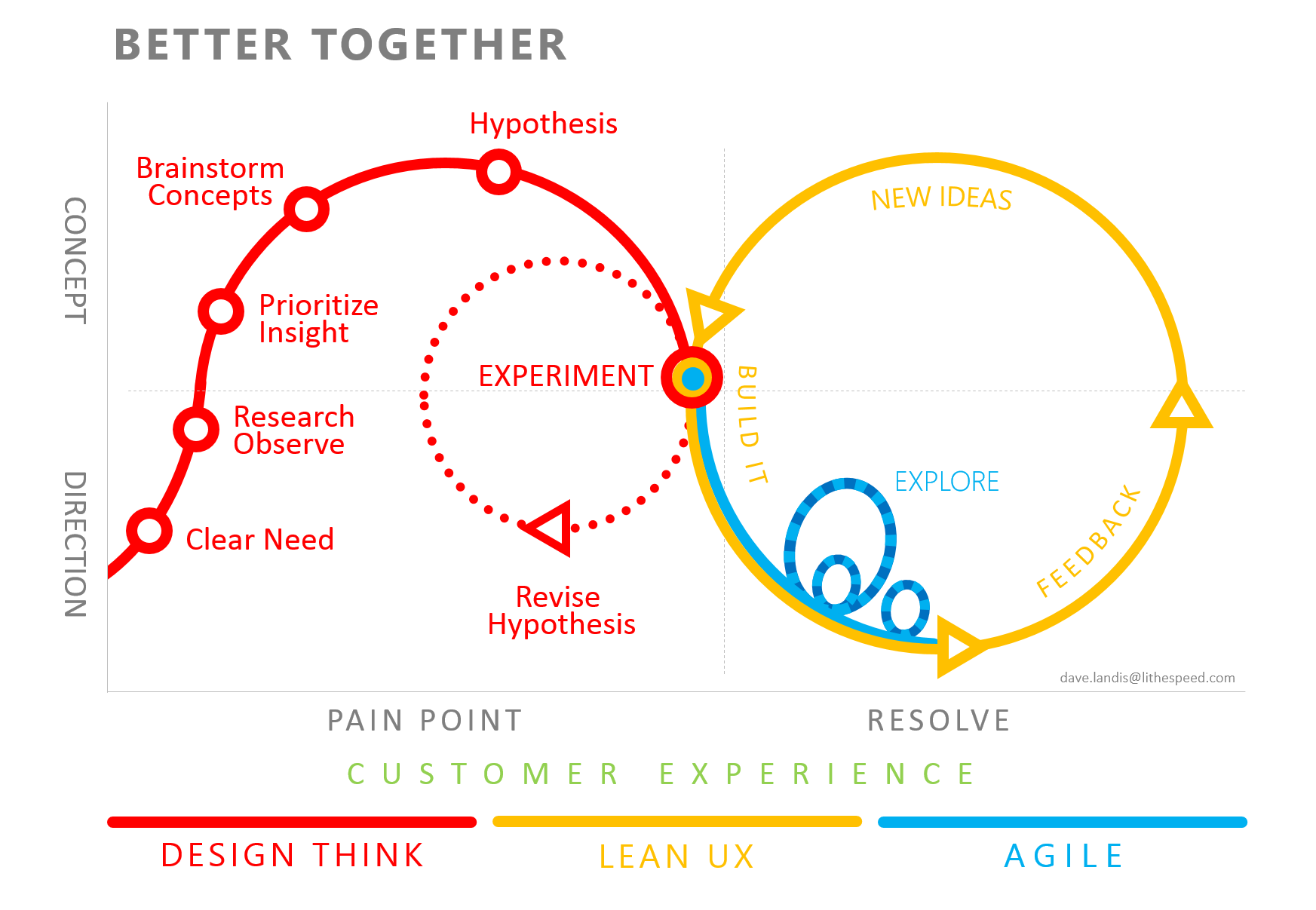
So all of that seems to be talking myself out of a job right? Not quite. There are several disciplines that have come to be bundled under the umbrella of UX professionally: Information Architecture, Interaction or UX Design, and sometimes UX Development and Copywriting. I am experienced in all four disciplines and have led teams made up of each for the last 6 years in the Minneapolis and St. Paul metro area. My main area of focus has been integrating Lean UX practices into Agile product teams and processes.
"Better Tegether" Image from Dave Landis.